Understanding Discrete Event Simulation (DES)
Discover how Discrete Event Simulation (DES) helps analyze complex systems, identify bottlenecks, and optimize performance for smarter business decisions.
In today’s data-driven world, Discrete Event Simulation (DES) stands out as one of the most powerful tools for analyzing and improving the performance of complex systems. Whether you’re optimizing a production line, managing warehouse operations, or studying traffic flow, DES allows you to model, test, and understand how systems behave—without disrupting real-world operations.
What Is Discrete Event Simulation?
At its core, DES is a computer-based modeling technique that represents a system as a sequence of distinct events in time. Each event marks a change in the system’s state—such as a machine starting, a product arriving, or a customer being served. Between these events, the system remains stable, allowing analysts to focus only on meaningful moments of change.
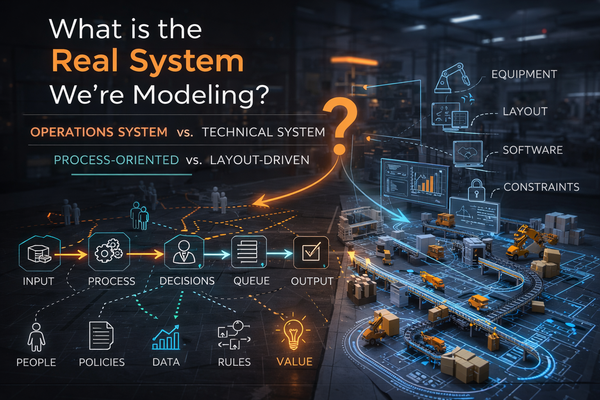
By simulating these events, DES helps visualize how processes interact, how queues form, and how decisions affect outcomes. This enables uncovering hidden inefficiencies, evaluating alternatives, and predicting system behavior under different conditions.
Why Use DES?
While no one can predict the future, DES allows us to anticipate how a system will respond to change. By experimenting with variables—like staffing levels, equipment configurations, or demand fluctuations—we can forecast performance, identify bottlenecks, and prevent costly failures before they occur.
Businesses use DES to:
- Evaluate operational efficiency and identify process bottlenecks.
- Test what-if scenarios without risking real-world disruption.
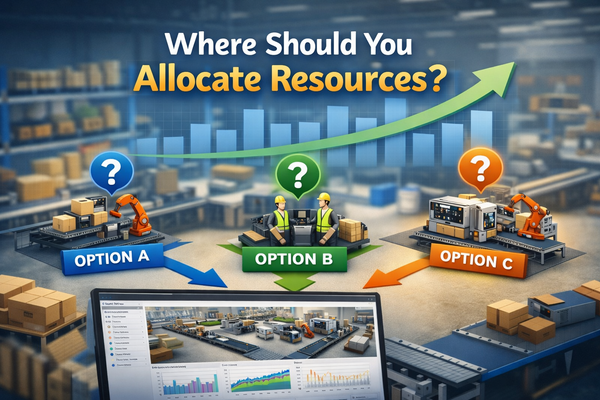
- Optimize resource allocation—such as labor, machines, or materials.
- Improve system reliability and service quality.
For example, a warehouse might use DES to determine the optimal number of workers for peak periods, or a manufacturing plant might simulate different production line layouts to find the most efficient configuration.
The Value for Business Decision-Making
DES empowers organizations to make data-driven, evidence-based decisions. Instead of relying on assumptions or intuition, managers can test ideas in a virtual environment and see how they perform before implementation. This not only saves time and money but also fosters continuous improvement across operations.
By identifying critical factors that influence performance, cost, and reliability, DES supports a more resilient and adaptable operation—one that can adjust quickly to new demands or disruptions.
Conclusion
Discrete Event Simulation is more than a modeling technique—it’s a strategic decision-making tool. It enables organizations to understand how their systems behave, anticipate future challenges, and optimize performance. By helping teams visualize complexity, reduce risk, and improve outcomes, DES becomes an essential asset for any business striving to operate smarter, faster, and more efficiently.