Understanding Simulation Modeling and Its Relationship with Artificial Intelligence
Discover how simulation modeling and artificial intelligence intersect to create more intelligent, adaptive, and predictive systems. Learn how AI enhances simulations for better decision-making, optimization, and risk reduction.
Artificial Intelligence (AI) refers to the simulation of human intelligence by machines—especially computer systems. These systems learn from data, reason through logic, and self-correct over time, with the goal of performing tasks that typically require human cognition.
In this article, we’ll explore the major domains that make up the field of AI, examine what simulation modeling is, and look at how these two powerful disciplines intersect. We’ll also discuss the advantages of integrating AI and simulation to create smarter, more adaptive systems.
Key Domains of Artificial Intelligence
AI is not a single technology—it’s an ecosystem of specialized domains that work together to enable intelligent behavior in machines. Understanding these domains provides valuable insight into how AI systems operate and where they can be applied.
Machine Learning (ML)
Machine Learning enables computers to learn from data and improve over time without being explicitly programmed. By analyzing examples, ML algorithms identify patterns and make predictions or decisions.
- Supervised Learning: Learns from labeled data with known outcomes.
- Unsupervised Learning: Finds hidden patterns or groupings in unlabeled data.
- Reinforcement Learning: Learns through trial and error, guided by rewards or penalties.
Deep Learning
A specialized form of ML, Deep Learning uses multi-layered neural networks to model complex patterns in data. It powers breakthroughs in image recognition, speech processing, and autonomous vehicles.
Natural Language Processing (NLP)
NLP bridges the gap between human language and computers. It enables systems to understand, interpret, and generate human language.
Applications: Chatbots, translation tools, virtual assistants, sentiment analysis.
Expert Systems
Expert systems replicate the reasoning of human experts using a knowledge base of facts and rules.
Applications: Medical diagnostics, financial analysis, and troubleshooting systems.
Robotics
Robotics combines AI with engineering disciplines to create machines that can sense, decide, and act autonomously.
Applications: Industrial automation, surgical robots, drones, and space exploration.
Computer Vision
This domain teaches machines to interpret and understand visual data from the world.
Applications: Facial recognition, autonomous vehicles, medical imaging, and surveillance.
Fuzzy Logic
Fuzzy Logic allows computers to handle partial truths—reasoning that isn’t just true or false, but somewhere in between.
Applications: Smart home systems, automotive controls, and adaptive decision-making.
Evolutionary Algorithms
Inspired by natural evolution, these algorithms evolve optimal solutions through mutation, selection, and crossover.
Applications: Engineering optimization, scheduling, and hyperparameter tuning.
Knowledge Representation and Reasoning (KRR)
KRR focuses on representing knowledge in a way that computers can reason about it.
Applications: Semantic web, intelligent assistants, and automated reasoning systems.
Neural Networks
Neural Networks are computational models inspired by the human brain. They process data through interconnected nodes (neurons) to identify and learn patterns.
Applications: Handwriting and speech recognition, stock prediction, and image analysis.
What Is Simulation Modeling?
Simulation modeling involves creating a digital representation of a real-world system to study its behavior under various conditions. It allows researchers and engineers to experiment, analyze performance, and test improvements—all without the cost or risk of real-world trials.
Applications: Manufacturing, logistics, healthcare systems, and airport operations.
Tools like FlexSim enable the creation of 3D simulations that visualize complex processes and test different scenarios. These simulations help identify inefficiencies, predict outcomes, and guide data-driven decision-making.
Although simulation modeling is not traditionally classified as a branch of AI, the two disciplines often intersect. When combined, simulation and AI create intelligent, adaptive, and predictive systems that can transform how organizations design and optimize their operations.
Where Simulation and AI Intersect
AI Techniques Inside Simulations
AI algorithms—such as machine learning and optimization—can enhance simulations by introducing adaptive behavior and predictive capabilities.
Example: Using ML to predict system performance under new conditions based on previous simulation data.
Agent-Based Modeling
In agent-based modeling, individual “agents” represent people, machines, or entities that interact based on defined rules. With AI, these agents can learn, adapt, and make complex decisions.
Applications: Social systems, economic modeling, traffic flow, and crowd dynamics.
Reinforcement Learning in Simulation
Reinforcement learning trains agents through simulated trial and error, allowing them to discover optimal strategies before real-world deployment.
Applications: Robotics, autonomous systems, and control optimization.
Optimization and Scheduling
AI-driven optimization techniques like genetic algorithms can fine-tune simulation parameters to discover the most efficient system configurations.
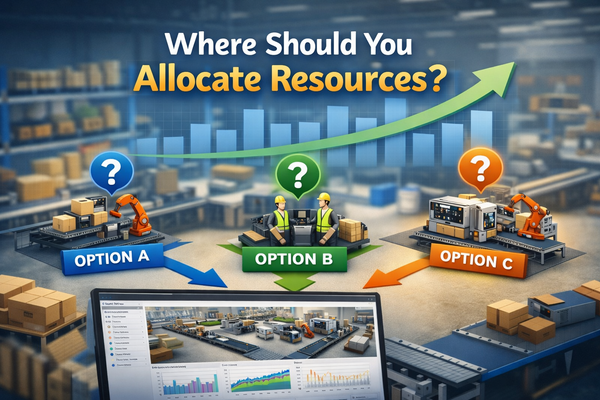
Example: Resource allocation optimization in a simulated manufacturing environment.
AI-Powered Data Analysis
Simulations generate vast amounts of data. AI can analyze these outputs to uncover hidden trends, detect anomalies, and support better decision-making.
Benefits of Combining Simulation and AI
Smarter Decision-Making
Integrating AI with simulation provides decision-makers with predictive insights and data-driven recommendations—reducing uncertainty and improving strategic planning.
Cost and Time Savings
Simulations minimize the need for costly physical testing, while AI automates data analysis and scenario optimization—shortening development cycles.
Greater Accuracy and Predictive Power
AI enhances simulation accuracy by identifying complex relationships in data and improving model fidelity.
Adaptive and Intelligent Systems
With AI integration, simulations can evolve as new data emerges, creating more dynamic and realistic models that respond to change.
Risk Mitigation
Simulations help detect potential issues before they arise in real-world systems. AI amplifies this benefit by spotting subtle warning signs and suggesting preventive measures.
Conclusion
The convergence of simulation modeling and artificial intelligence represents a powerful evolution in how we analyze, predict, and optimize complex systems. Together, they provide organizations with tools to innovate, reduce costs, and manage uncertainty with confidence.
As AI continues to advance, its integration with simulation will lead to even more intelligent and adaptive models—ones capable of learning from data, anticipating outcomes, and optimizing themselves in real time.
The synergy between simulation and AI isn’t just a technological enhancement—it’s a strategic advantage for any organization striving to navigate today’s complex, data-driven world.
References and Resources
[1] S. J. Russell and P. Norvig, Artificial intelligence: a modern approach, Fourth edition. in Pearson series in artificial intelligence. Hoboken: Pearson, 2021.
[2] A. M. Law, Simulation modeling and analysis, Sixth edition. New York: McGraw Hill, 2023.