Where Is the Bottleneck? A Practical Guide to Simulation Modeling and Analysis
Operational problems rarely announce themselves. Instead, queues silently expand, delays accumulate, and throughput declines mysteriously.
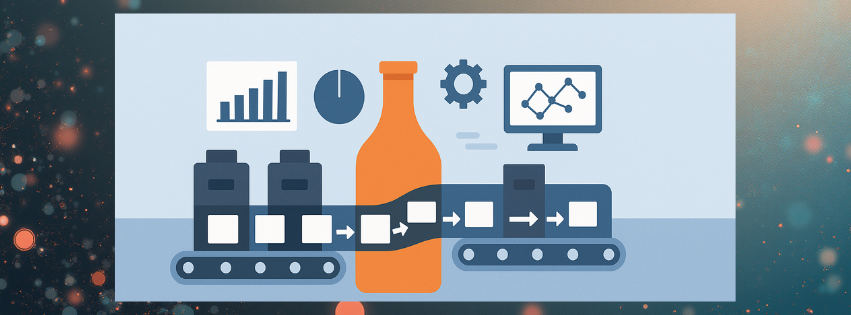
Operational problems rarely announce themselves. Instead, queues silently expand, delays accumulate, and throughput declines mysteriously. Whether you manage an airport, run a manufacturing line, or oversee a service operation, the question remains the same:
Where is the Bottleneck?
Simulation modeling provides the clarity you need. When built and analyzed correctly, a simulation model reveals constraints, exposes hidden inefficiencies, and gives you a safe environment to test improvements—before making changes in the real world.
This article presents a structured, industry-neutral method for identifying and resolving bottlenecks through simulation modeling and Lean principles.
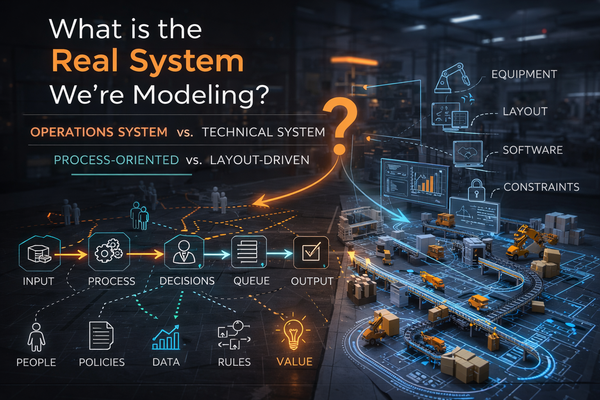
Map the Process
Start with a clear depiction of the actual workflow. Your model is only as good as your understanding of the system.
Build the Process Flow
A process flow should capture:
- Major steps
- Resource interactions
- Routing rules
- Decision points
- Physical or logical movement
Use the mapping approach that best fits your system—flowcharts, BPMN, operational block diagrams, or swimlanes.
Industry Examples
Airport:
Passenger check-in → security screening → departure lounge → boarding
Manufacturing:
Raw material receiving → assembly → inspection → packaging → shipping
Service:
Customer request → triage → service delivery → wrap-up → billing
Collect Data and Define Model Inputs
A model without real data is just a cartoon.
Gather the operational parameters that drive real behavior:
- Processing/cycle times
- Setup or turnaround times
- Failure/downtime distributions
- Arrival patterns (passengers, jobs, calls, items)
- Resource capacities and schedules
- Queue rules (FIFO, priority, batching, etc.)
Your simulation should reflect variability, not just averages.
Run and Observe the Simulation
When you run the model, you’re not just looking for overall throughput—you’re looking for patterns.
Monitor:
- Queue lengths
- Work-in-Process (WIP)
- Resource utilization
- Waiting times
- Throughput and variability
- Time-in-system
It’s the relationship between these metrics, not any single number, that exposes constraints.
Identify the Bottleneck
A bottleneck is the point where demand exceeds capacity.
Signs include:
- The longest persistent queue
- The resource operating near 100% utilization
- The step that governs system throughput
- Long or volatile waiting times
Industry Common Examples
Airport:
Security screening machines consistently run at maximum load while queues stretch into the concourse.
Manufacturing:
A specific CNC machine becomes the gating station because everything upstream waits for its availability.
Service:
A single triage nurse or specialist becomes the limiting factor in how quickly customers are served.
Apply Lean Thinking to Improve Flow
Simulation tells you where the problem is. Lean principles help you understand why the problem exists—and what to do next.
Value Stream Mapping
Create a Value Stream Map (VSM) to see:
- End-to-end flow
- Total lead time
- Waiting vs. processing time
- Hidden constraints
- Waste (Muda) and unevenness (Mura)
The VSM complements your simulation by grounding it in reality.
Pull Systems & Flow
Lean prioritizes:
- Reducing variability in the bottleneck
- Smoothing arrivals
- Limiting WIP (work-in-process)
- Stabilizing flow instead of pushing demand
Improving throughput at the bottleneck often improves the entire system.
Continuous Improvement (Kaizen)
Once you identify the constraint, implement measurable improvements:
- Reduce setup/turnaround times
- Remove unnecessary steps
- Improve scheduling
- Add or rebalance capacity
- Standardize work
Then re-run the simulation to verify that:
- The bottleneck is truly improved
- No new bottlenecks have emerged
Conclusion
Finding the bottleneck isn’t guesswork. It’s a disciplined analysis.
Simulation modeling gives you a dynamic, risk-free way to understand how your system truly behaves. Combined with Lean principles, it gives you the tools to:
- Identify constraints
- Improve flow
- Reduce waiting
- Increase throughput
- Support better decision-making
This approach applies to any industry—airports, factories, warehouses, hospitals, call centers, and beyond.