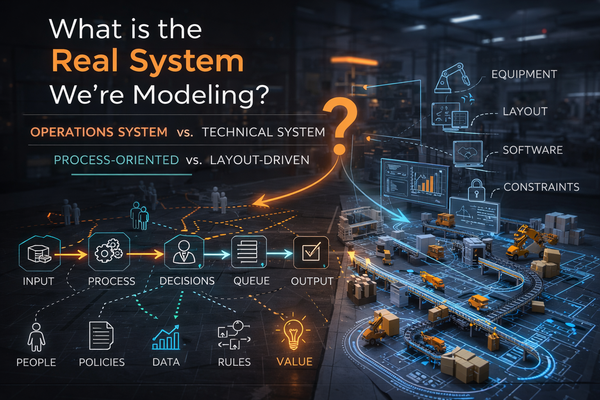
What is the real system we’re modeling?
Most simulation failures don’t come from bad logic — they come from modeling the wrong system.

Most simulation failures don’t come from bad logic — they come from modeling the wrong system.
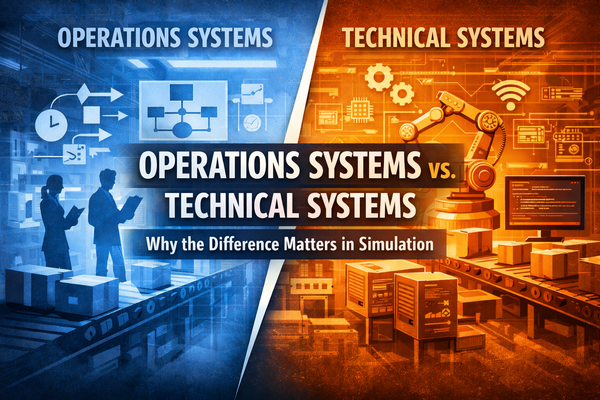
An operations system is not the same thing as a technical system. While technical systems focus on machines, software, and reliability, operations systems define how value is actually delivered through people, processes, and flows.
AEDT 4a released. This Simlog examines the practical implications of the release, with a focus on modeling-relevant changes, including platform upgrades, enhancements to helicopter operations, emissions updates, and modifications to climb performance assumptions, and compliance workflows
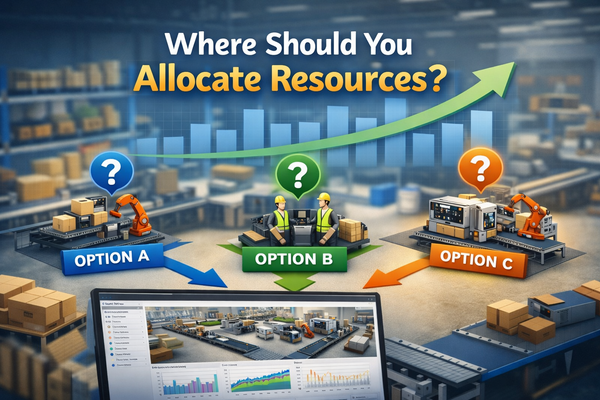
Simulation Modeling and Analysis 1. Scenario Testing * Create multiple scenarios in the simulation model. For instance, add or remove a machine or operator at different stations and observe the outcomes. 2. Key Metrics * Track lead time, throughput, and resource utilization for each scenario. * Compare scenarios to see which resource allocation
Creating a clear, structured process flow is the foundation of any effective simulation model. Whether you’re analyzing a manufacturing line, an airport operation, or a service workflow, the goal is the same: define the activities, connect them logically, allocate the right resources, and control the flow of events. This
Simulation Modeling and Analysis 1. Dispatching Rules * Program or set different scheduling heuristics (e.g., First-In-First-Out (FIFO), Earliest Due Date (EDD), Shortest Processing Time (SPT), etc.) in your FlexSim model. 2. Batch or Sequence Comparison * Experiment with various sequences in simulation (e.g., schedule high-priority orders first vs. regular jobs
Simulation Modeling and Analysis 1. Downtime Modeling * Build probability distributions or schedules for resource downtime in your FlexSim model (e.g., Mean Time Between Failures (MTBF) and Mean Time To Repair (MTTR)). 2. Scenario Analysis * Run scenarios where a critical machine fails for a certain duration. Observe queue build-up, lead

Operational problems rarely announce themselves. Instead, queues silently expand, delays accumulate, and throughput declines mysteriously.

Understand the difference between operations and technical systems, and when to use FlexSim Manufacturing vs. Factory. Includes a comparison table, case study, and downloadable diagram.

Simulation empowers Industry 4.0 by enabling virtual testing, optimization, and innovation—bridging the gap between digital design and real-world production.
Agent-Based Modeling simulates how individual agents interact to reveal complex system behaviors, helping researchers test, predict, and understand change.
System dynamics helps analyze and improve complex systems by modeling feedback, behavior, and change—turning complexity into actionable insight.
How-To
Discover how Discrete Event Simulation (DES) helps analyze complex systems, identify bottlenecks, and optimize performance for smarter business decisions.

How-To
Simulation modeling helps scientists, engineers, and businesses analyze, predict, and optimize complex systems — from weather and biology to manufacturing and markets. Discover how simulation turns data into insight and ideas into action.

How-To
Learn how to design efficient manufacturing work cells using FlexSim simulation. Explore benefits like waste reduction, cross-training, and improved flow through virtual prototyping and data-driven optimization.

How-To
Discover how simulation modeling and artificial intelligence intersect to create more intelligent, adaptive, and predictive systems. Learn how AI enhances simulations for better decision-making, optimization, and risk reduction.

How-To
Discover how understanding and eliminating Muda—the Japanese concept of waste—can dramatically improve manufacturing efficiency. Learn its history, the eight types of waste, and practical ways to reduce Muda for lasting productivity gains.

How-To
Discover how simulation with FlexSim helps manufacturers identify and eliminate Muda (waste), Mura (unevenness), and Muri (overburden). Learn how data-driven simulation supports lean efficiency, safety, and continuous improvement.
How-To
One-piece flow transforms manufacturing by eliminating waste, reducing lead times, and improving quality. Learn how simulation with FlexSim empowers manufacturers to analyze, optimize, and implement continuous flow systems with precision—bridging the gap between lean theory and practical execution.
How-To
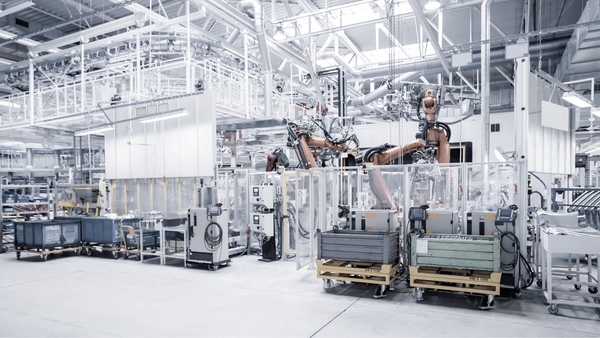
Discover how combining lean thinking with FlexSim simulation unlocks new levels of manufacturing efficiency, driving continuous improvement, waste reduction, and innovation.
How-To
FlexSim creates a virtual model of your manufacturing process, a digital twin of your operation. This allows engineers and managers to visualize workflows, simulate scenarios, and test improvements in a controlled environment. Simulation provides measurable evidence
How-To
Fixating on what-if questions invites doubt, which breeds confusion and fear. A worried mind hesitates, leading to procrastination and halting progress. The simple but powerful antidote is to focus on facts, not fears, as facts ground us in reality. Stop guessing—simulate.

How-To
Continuous improvement drives manufacturing excellence. This article explores how integrating A3 thinking—a lean problem-solving approach—with simulation tools like FlexSim can enhance decision-making, streamline analysis, and boost confidence in solving complex manufacturing challenges.